Heritage Funicular

Do you know... the Montmartre funicular?

Opened in 1900, the Montmartre funicular is an iconic feature of the Butte neighbourhood. Find out more about its history!

Summary

  1. Why the need for a funicular railway?
  2. 1900: Birth of a water-ballast funicular railway
  3. 1935: Make way for electric traction!
  4. 1991: A new, upgraded funicular railway
  5. The Montmartre funicular, a symbol of local life
  6. A means of transport like any other
  7. The funicular and RATP staff members
  8. 2026: A major overhaul to ensure safety
  9. What about the Bellevue and Belleville funiculars?

Why the need for a funicular railway?

The history of the Montmartre funicular is closely linked to that of Sacré-Cœur Basilica.

Built at the summit of the Butte in response to a vow made in the aftermath of the Paris Commune, work on the basilica began in 1873. To transport materials more easily to the construction site, an inclined plane was created. A first rudimentary system was installed: a simple wagon, hoisted by means of a winch.

Completed in 1891 and open for worship ever since, the basilica remained difficult to access. Visitors had to climb no fewer than 220 steps to reach its forecourt. The Paris City Council thus considered creating a proper funicular railway to transport passengers on the site of the former inclined plane as early as 1898.

The Montmartre funicular was built at the beginning of 1900 and finally offered simpler and more comfortable access to the Butte and Sacré-Cœur Basilica.

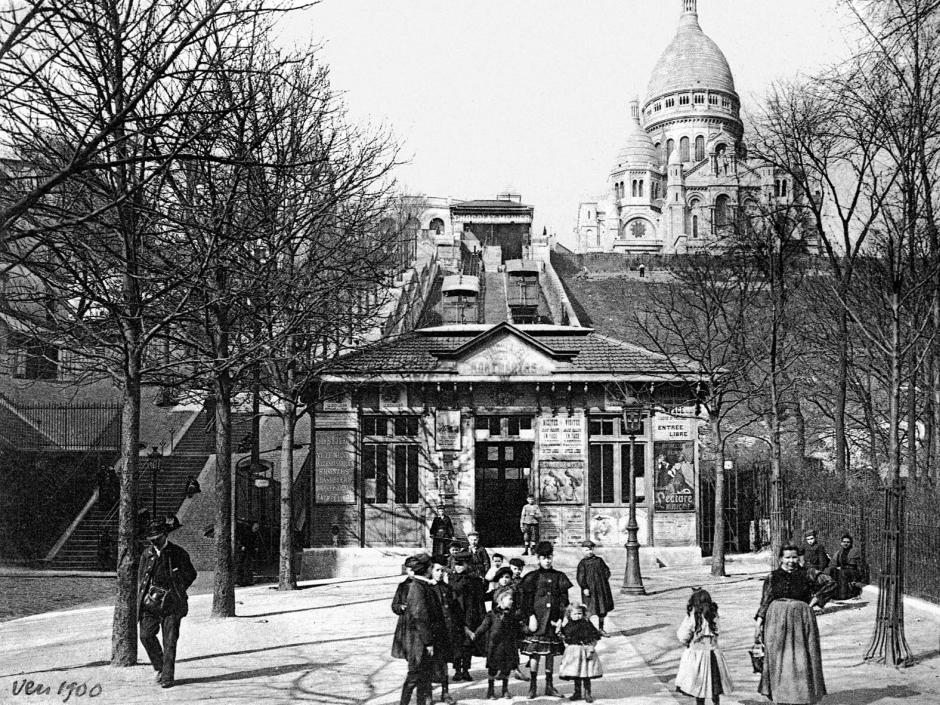
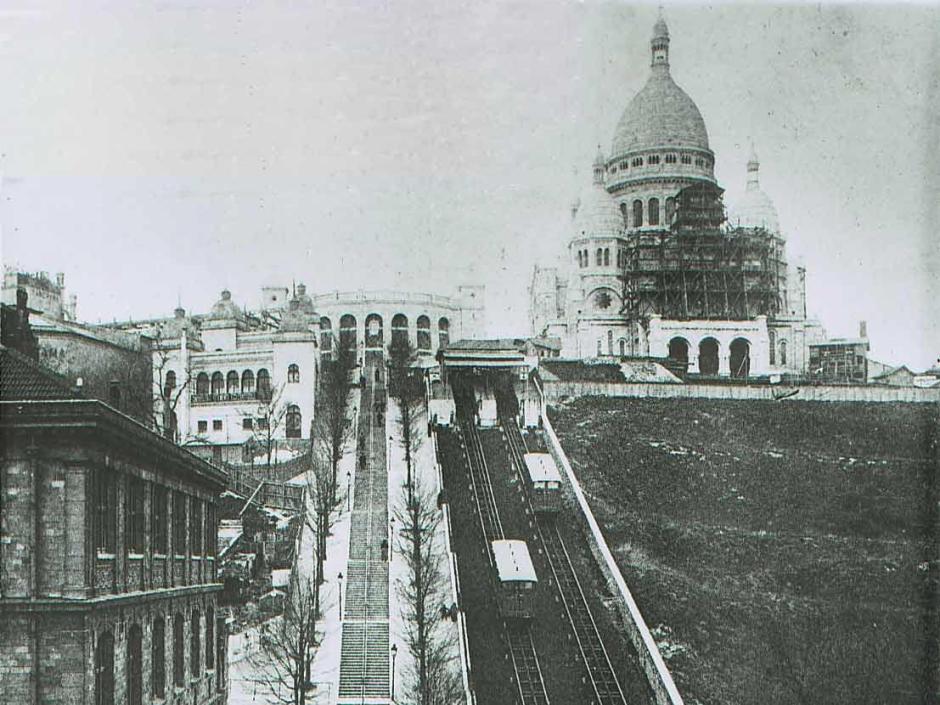
The Montmartre funicular in 1900

1900: Birth of a water-ballast funicular railway

The line was first opened on 12 July 1900. It linked Place Saint-Pierre to the basilica’s terrace, running alongside the square over a distance of 108 metres with a 36-metre climb.

At the time, the funicular railway consisted of two parallel tracks along its entire length. Each track lay on steel sleepers, which were in turn supported by a concrete foundation. A Strub rack was installed down the centre of each track, designed to provide emergency braking.

Two carriages ran on the line, with one going up as the other came down. Connected by a cable at the top of the line, they operated using an ingenious counterweight system. With a capacity of 48 passengers, the carriages featured a stepped body divided into four enclosed compartments, as well as two open platforms at either end reserved for the brakeman.

The operating principle was based on a vast water tank located under each carriage. At the upper station, the tank of the descending carriage was filled, making it slightly heavier than the ascending carriage. This difference in weight was all it took to pull both carriages up and down the slope. Once it arrived at the lower station, the descending carriage emptied its tank into the city’s water mains.

This first passenger funicular railway quickly became a huge success, transporting up to a million people each year. At the time, a ticket cost 0.10 francs to go up and 0.05 francs to come down.

The City of Paris granted the concession to operate the line to the company Decauville. This concession expired on 22 March 1931 and was subsequently extended until 1 November of the same year. By this time, major repairs had become necessary, and the funicular was finally taken out of service. The City of Paris then decided to completely rebuild the facility on the site of the former funicular railway and to replace the water-ballast system with electric traction.

Lower station of the funicular railway (1903)
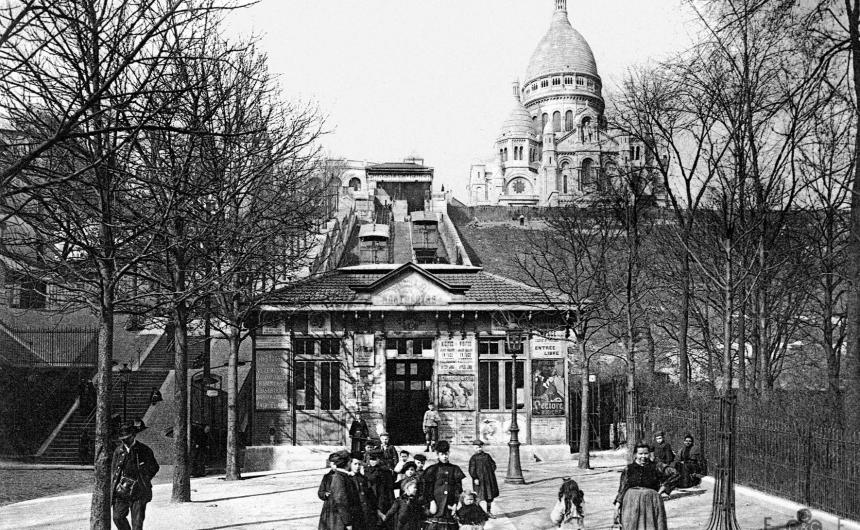
The Montmartre funicular and Sacré-Cœur (1905)

1935: Make way for electric traction!

In 1933, the City of Paris and the Seine département entrusted the operation of the funicular railway to the Société des transports en commun de la région parisienne (STCRP), following an attempt in 1931 to replace it with a bus on the BB line.

In just one year, STCRP completely transformed the facility. The counterweight principle was retained, but hydraulic power was replaced by electric traction.

The new funicular railway entered service on 2 February 1935. Both tracks now lay on a concrete bed and the rack was removed. Emergency braking was provided by jaws that clamped directly onto the running rails.

The new carriages abandoned their stepped configuration in favour of a flat floor and therefore could now accommodate up to 50 passengers. They were pulled by a winch driven by a 50-horsepower electric motor, allowing the journey to be completed in 70 seconds.

Photos of the electric funicular railway (1935) and a diagram comparing the old and new carriages (1935)

In 1942, on the merger of STCRP with the Compagnie du chemin de fer métropolitain de Paris, operation of the funicular was taken over by the latter. Subsequently, RATP assumed responsibility for operating the line when it was established on 1 January 1949.

RATP
Departure platform of the electric funicular railway, cabins passing each other, and cabin interior (1949)
RATP

In 1955, the service ran from 7:00 a.m. to 9:00 p.m. in winter and until 11:00 p.m. in summer. Payment for the journey was made at the station entrance by clipping a bus ticket.

Passenger numbers rose steadily over the decades: from approximately 1.2 million passengers a year in the 1950s to 2.3 million in 1989. 21% of passengers were regular users, while the remaining 79% were occasional passengers, mainly tourists. A number of improvements were also made to the facilities. Notably, the cabins were updated and fitted with an aluminium body. In 1965, the automation of operations meant that staff no longer needed to be present on board the cabins.

RATP
Reproduction of an RATP poster (1956) – Access to the lower station (1956) – Interior of the lower station (1960) – Lower station ticket hall (1960) – Upper station (1962) – Panoramic view from the Butte Montmartre (1981)
RATP

1991: A new, upgraded funicular railway

At the end of the 1980s, the dilapidated state of the 1935 funicular railway and the growing passenger numbers made an upgrade essential. Operations on the old system ceased on 30 September 1990, and it was fully replaced by a new facility commissioned on 5 October 1991.

The counterweight system for the carriages was discontinued in favour of two independent cabins, each equipped with its own drive system. This configuration enables service to continue with just one cabin while maintenance work is being carried out on the other.

RATP
Renovation work on the funicular railway (1990-1991)
RATP

The new cabins, with a flat floor and large windows, can carry up to 60 passengers and reach a speed of 3.5 metres per second. The funicular thus offers a capacity of 2,800 passengers per hour going uphill, with a waiting time of less than five minutes.

It is fully automated and the service can be adapted to passenger numbers, with just one cabin running during off-peak hours.

The upgrade included reconstruction of the two stations, designed by the architect François Deslaugiers, while the cabins were designed by Roger Tallon. Clear glass, satin-finish grey metal and curved lines come together to create a design that is modern, transparent and understated, blending into the Montmartre landscape harmoniously.

RATP
Stations and cabins of the funicular railway inaugurated in 1991, designed by Roger Tallon (1991-1992)
RATP

The Montmartre funicular, a symbol of local life

A true lifeline connecting residents, professionals, and visitors alike, the Montmartre funicular is an integral part of daily life on the Butte. The City of Paris gardeners, responsible for maintaining the park on the Butte Montmartre, use it every day to get to work. Open every day from 6:00 a.m. to 12:45 a.m., the funicular also sets the pace for the shopkeepers on the Butte, who adapt to its opening hours.

Lastly, during major local events such as the Montmartre Grape Harvest Festival, the funicular railway becomes a must-see attraction. During this major event it experiences an exceptional surge in passenger numbers, perfectly illustrating its dual role: not just as a means of transport, but as a vital part of Montmartre life.

RATP
Lower station of the funicular railway (2010)
RATP

A means of transport like any other

Incorporated into the metro network, the Montmartre funicular carries millions of passengers every year with numbers reaching 3.6 million in 2025, including both local residents and visitors coming to explore the Butte Montmartre.

The journey itself is an experience in its own right: it takes just over a minute to get from the foot of the Butte to Sacré-Cœur. The current cabins retain the same style as those that entered service in 1991. Originally designed to carry 60 passengers, they now carry a maximum of 35 people, to ensure their comfort and safety.

In 2025, a number of improvements were made to enhance passenger comfort. Protective films have been fitted to the cabin windows to filter out UV rays and limit the greenhouse effect, thereby reducing the heat felt on board on sunny days.

Since 9 July 2026, the funicular has offered contactless card payment of the €2.55 fare, the same price as a standard travel ticket. This development makes it even easier for occasional passengers to use, notably tourists.

RATP
Tourists wait at the lower station to board the funicular railway (2014)
RATP

The funicular and RATP staff members

Behind its apparent simplicity, the funicular railway operates in a very specific way, similar to a lift. In fact, it is maintained by lift engineers who specialise in this type of equipment.

Around 60 RATP staff members are authorised to operate it on a day-to-day basis. These staff members, who are based in the western sector of metro line 2, also have foreign language skills to assist the many international visitors. They are responsible for opening and closing the facility and for starting it up.

Did you know? For aesthetic reasons, the station access gates retract directly into the floor so that they are not visible when opened. The problem is that they have to be raised manually using a small crank handle in the event of a power cut. This can take between 30 and 40 minutes!

2026: A major overhaul to ensure safety

To ensure the safety and reliability of the facility and the comfort of passengers, the Montmartre funicular undergoes a major regulatory overhaul every ten years, or every 20,000 hours of operation. The most recent overhaul took place from mid-January to mid-June 2026.

A spectacular moment during this operation was the removal of a 7 t cabin using a crane. It was hoisted to a height of 22 metres before being transported to Albi, where it was completely dismantled and serviced. The seating, floor and glass walls were all refurbished. The chassis, wheels, and motor were sent to the Hautes-Pyrénées region for servicing.

While the work was being carried out, the funicular continued to operate with a single cabin, except during the removal and re-installation operations. This arrangement enables the route – used by 3.6 million passengers every year – to remain in service, while preparing the funicular for another decade of operation.

RATP - Xavier Chibout
Removal of a funicular cabin for its regulatory overhaul (2026)
RATP - Xavier Chibout
What about the Bellevue and Belleville funiculars?

The Bellevue funicular

Opened in 1893 in Meudon, the Bellevue funicular was intended for tourists: it enabled visitors arriving from Paris by boat or via the western railway to reach the Meudon Forest. Linking the banks of the Seine to the Puteaux–Issy-Plaine line, it climbed a 30% gradient using a rack-and-pinion system.

After reaching a peak of 312,000 passengers in 1911, passenger numbers declined in the wake of the First World War. Staff being called up for military service, followed by the rise of the motor car, led to its closure in 1934. The line was later dismantled.

The Belleville funicular

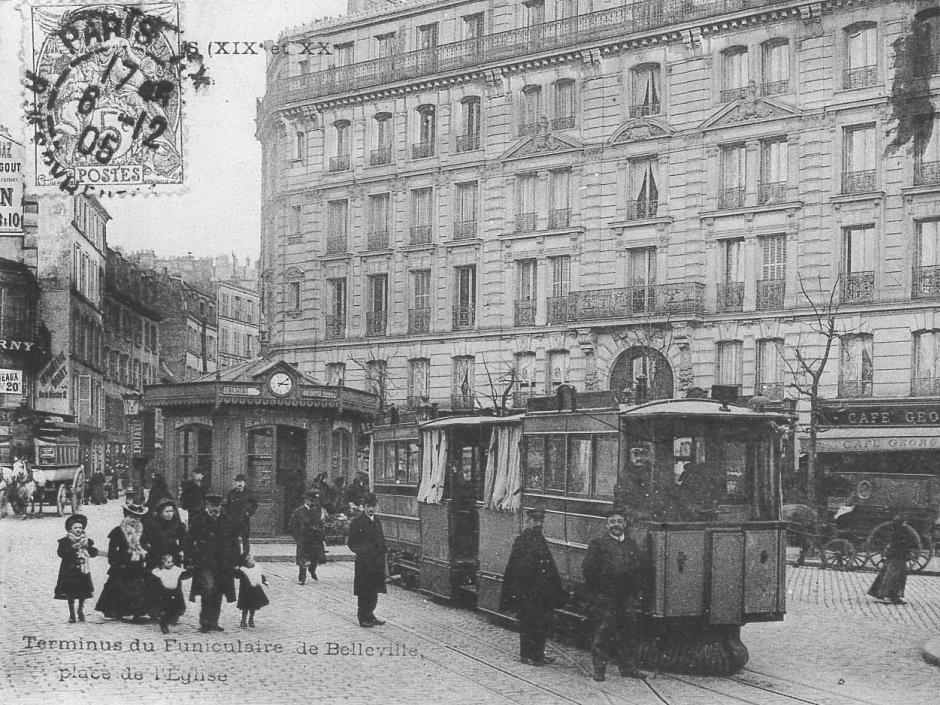
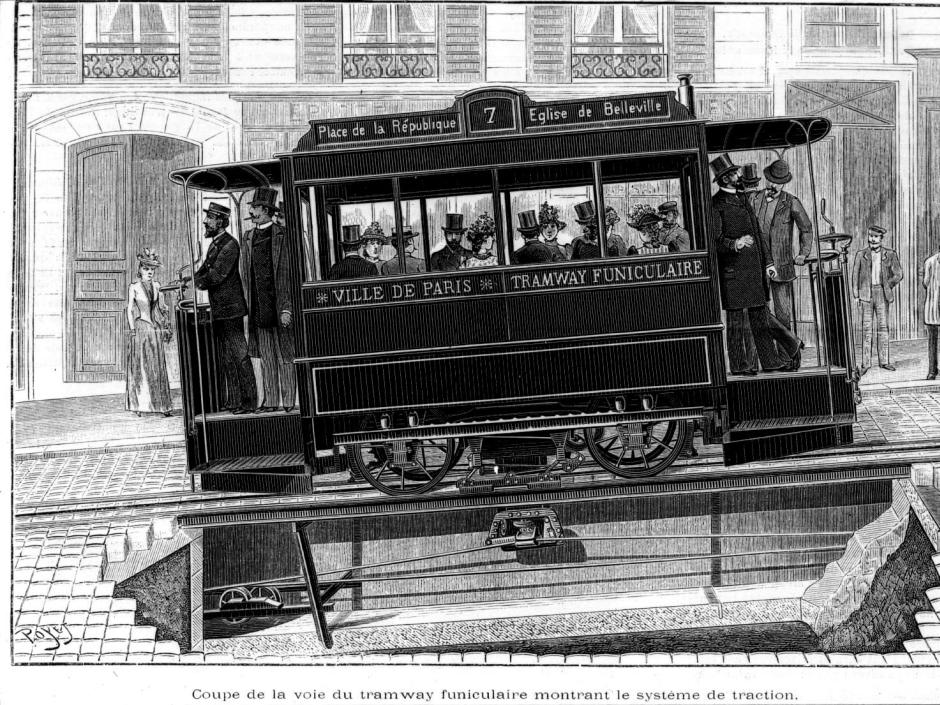
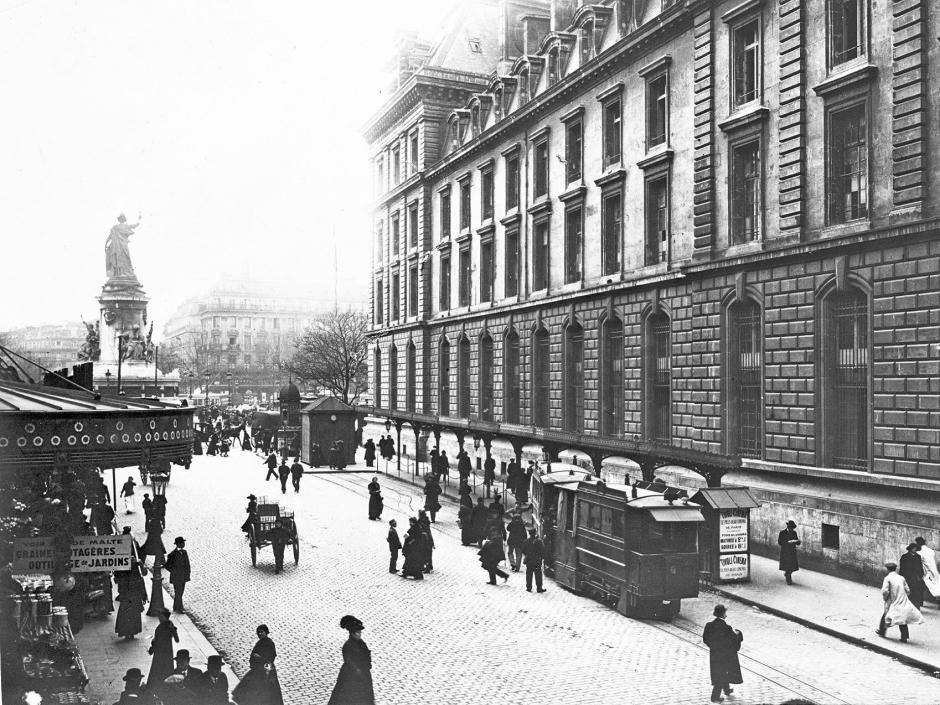
Opened on 25 August 1891, the Belleville funicular linked Place de la République with the Belleville church. It was notable for its endless-cable traction system, chosen due to the narrowness of Rue de Belleville, which did not allow for the installation of two separate tracks.

Cross-section of the funicular tramway track showing the traction system
Terminus of the Belleville funicular, Place de la République, Paris, in 1905
Terminus of the Belleville funicular, Place de l’Eglise, Paris, in 1905

Initially operated by a concessionary company led by the engineer Fournier, it came under the control of the City of Paris in 1910, before becoming part of STCRP in 1921. Plagued by regular cable wear and high maintenance costs, it was closed down in 1924 and replaced by a bus route. Its route was eventually taken over by metro line 11 in 1935.

Heritage Funicular