Together, let’s combat harassment in public transport

The RATP is working with multiple stakeholders to combat harassment on public transport. Several alert systems are in place, and safe areas are available to passengers if needed. Here's how it works!

Summary

  1. Several ways to report incidents
  2. How to report incidents of sexual or gender-based harassment
  3. A bus to teach middle and high school students how to respond to sexual harassment
  4. A look back at influence operations to raise awareness among young people

We want everyone to have the safest and most peaceful journey possible. That is why combating harassment on public transport is a priority for RATP.

Several ways to report incidents

A single hotline: 3117

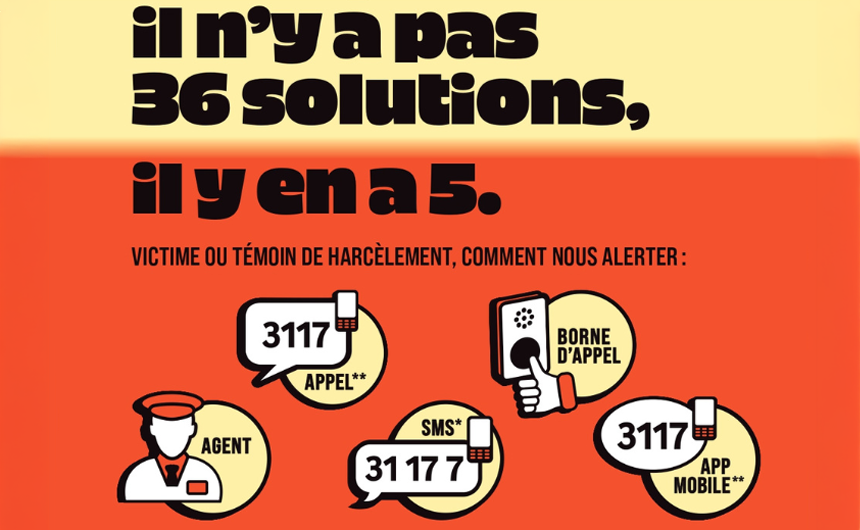
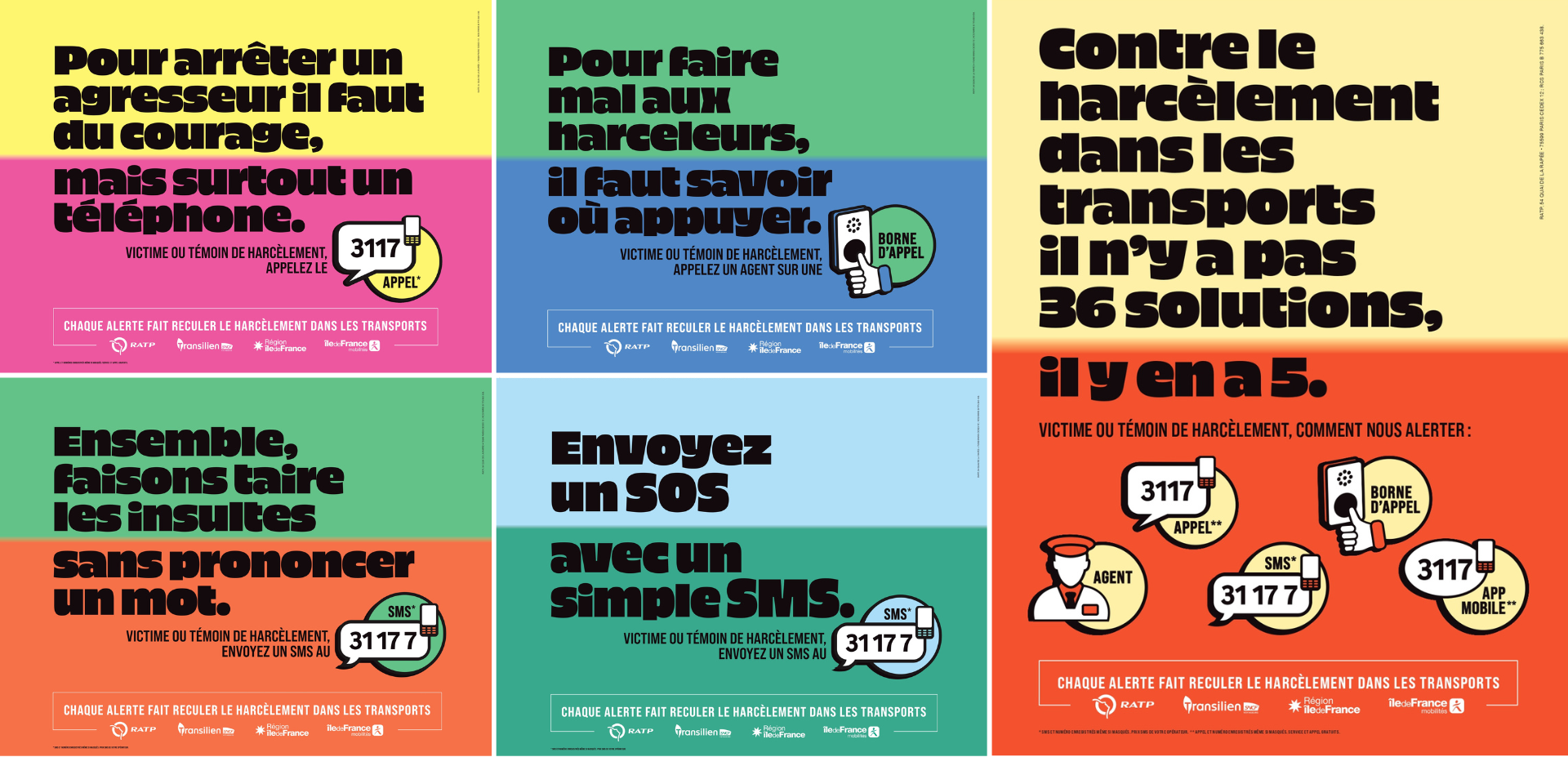
Are you familiar with 3117? It is a dedicated toll-free emergency number for reporting any assault or harassment on the Île-de-France transport network. RATP, SNCF, the Île-de-France Region, and Île-de-France Mobilités have joined forces to create this single number for reporting incidents. The number 3117, and by text message 31 17 7, is available 24 hours a day. A 3117 app has also been developed, allowing users to be put in direct contact with an operator on the platform.


Agents present in stations via call points

Another solution is available to you if you have been a victim of gender-based and sexual violence: you can contact station staff via the emergency call boxes.

Since 2020, all station and terminal staff have been trained to assist victims and witnesses. In the event of an assault, staff collect statements, refer victims to support services, and encourage them to file a complaint. This system, which will be extended to bus and tram networks in 2022, makes RATP a pioneer among transport operators.

Safe spaces to seek refuge

With the support of Île-de-France Mobilités, RATP offers safe places labeled “Safe Place UMAY.” These places allow victims of sexual harassment on public transportation to be welcomed and brought to safety in certain stores on the Île-de-France Mobilités network.

After the first three shops—Avril, RELAY/Fnac, and Monop'—launched the scheme at Auber station in 2023, 64 new certified safe places located along the T3b tram route were listed on the UMAY app in 2024.

Since the start of the 2025 school year, 69 new locations certified as “Safe Places” have been added along the T3a tram route. A total of 154 safe places will now be listed on the UMAY app once employee training has been completed. Employees at these locations have been trained by UMAY to know how to assist victims of gender-based and sexual violence.

safe place Umay
 

Security officers and video surveillance

Over 1,000 security officers are stationed across the network, and ready to intervene at any time. The network protection and security unit, consisting of approximately one hundred teams deployed every day, works closely with the Paris police prefecture’s Île-de-France network brigade.

In addition to the human presence, over 50,000 surveillance cameras have been installed in metro and RER stations, on platforms, in corridors, and on board vehicles. Camera footage can be used when passengers file complaints with the Paris police prefecture.
 

On-demand stops

On-demand stops between two stops are now possible on all bus routes in the Paris region after 10 p.m. Don't hesitate to ask the bus driver!

Handling situations with the 5D method

RATP also supports the international Stand Up training program. Launched by L'Oréal Paris, the NGO Hollaback! and the Fondation des Femmes, its goal is to raise awareness and train as many people as possible to intervene safely when they are victims or witnesses of sexual harassment in public places.

Stand Up was created around the “5D” methodology: DISTRACT, DELEGATE, DIALOGUE, DIRECT, and DOCUMENT, a list of actions to take in order to defuse a harassment situation. In practice, this consists of:

  • Distracting: pretend that you know the person being harassed. Ask them for the time or create a distraction.
  • Delegating: look for a figure of authority or a third party, and ask them for help in intervening.
  • Documenting: secretly film the unfolding situation, and offer to provide the victim with proof or a statement.
  • Directing: talk directly to the harasser, and ask them to stop harassing the victim.
  • Delaying: talk to the victim after the incident, and tell them that what they have just experienced is not acceptable.

The training programme is available on line and free of charge. Visit the Stand Up website for more information.

How to report incidents of sexual or gender-based harassment

Were you a victim of sexual or gender-based assault and would like to report it? You can also use the dedicated form to report an incident at the place where it occurred: 

Your statement will give us a clearer idea, and help us to better understand what goes on in our stations, and where to deploy our security officers.

A bus to teach middle and high school students how to respond to sexual harassment

L'Oréal Paris, the Fondation des Femmes, and the RATP continued their campaign against street harassment with two new initiatives: one in Châtillon on April 8 and 10, 2025, and one in Paris in front of the Lycée Hélène Boucher in the 20th arrondissement on April 9, 2025.

Middle and high school students received free Stand Up training, a program created in 2020 by L'Oréal Paris in partnership with Right to Be and the Fondation des Femmes, which taught them how to respond to sexual harassment in public spaces.

For three days, a specially equipped RATP bus was transformed into a mobile training center. This symbolic choice underscores the ambition to make public spaces, particularly transportation, safer for everyone. This initiative is part of RATP's efforts to combat sexual harassment on its networks.

Xavier Chibout - RATP
Raising awareness about combating sexual harassment in a high school (2025)
Xavier Chibout - RATP

A look back at influence operations to raise awareness among young people

Participation in the “Night Confessions” podcast

In 2025, Sandrine Charnoz, head of the fight against sexual harassment in transport at RATP, took part in the “Night Confessions” podcast, which is very popular with the community of its host, Manon Delcourt, alias Dairing Tia.

This 181st episode, devoted to the theme of harassment, was an opportunity to raise awareness among listeners about the issue and explain the measures put in place by the RATP to combat it, through an intimate and informal conversation.

Listen to the Night Confessions podcast below!


Operation #firstresponse

In 2022, RATP joined forces with Sarah La Crieuse, an influencer who has become a leading figure in the fight against street sexual harassment. This collaboration, shared on TikTok, the favorite social media platform of young people, took place as part of a unique campaign for the start of the school year, combining testimonials from young passengers with advice from staff members. The goal: to raise awareness among young passengers.

@ratpofficiel Quels sont vos premiers réflexes face à une situation de harcèlement dans les transports ? C'est la question que nous avons posée à 5 voyageurs dont @sarahlacrieuse. Rappel des bons réflexes : - Demander de l'aide à un agent dans la station ou via les bornes d'appel - Alerter par téléphone au 3117 ou par SMS ou 31177 #premiersreflexes #ratp #ratpsansfiltre ♬ son original - RATP

@ratpofficiel @Sarah nous pose les questions qui reviennent le plus souvent et c'est Sandrine notre Cheffe de projet Luttre contre le harcèlement sexuel dans les transports qui y répond. Rappel des bons réflexes : - Demander de l'aide à un agent dans la station ou via les bornes d'appel - Alerter par téléphone au 3117 ou par SMS ou 31177 #premiersreflexes #ratp #ratpsansfiltre ♬ son original - RATP