- Facebook is disabled. Authorize cookies to access to this feature. AllowPersonalizingAddtoany is disabled. Authorize cookies to access to this feature. AllowPersonalizing
- Twitter is disabled. Authorize cookies to access to this feature. AllowPersonalizingAddtoany is disabled. Authorize cookies to access to this feature. AllowPersonalizing
- Linkedin is disabled. Authorize cookies to access to this feature. AllowPersonalizingAddtoany is disabled. Authorize cookies to access to this feature. AllowPersonalizing
Summary
- The metro comes to the aid of a gridlocked capital
- The Paris metro: declared to be in the public interest before it even existed
- A resounding success right from day one
- A colossal construction project that continued until 1939
- Construction methods
- The metro makes its mark on the city’s heritage
- 1949: RATP is founded
- Travel tickets: goodbye ticket punchers, hello Navigo
- 125 years old in 2025
- Key dates in the history of the metro
The metro comes to the aid of a gridlocked capital
During the second half of the 19th century, notably during the Second Empire, as traffic volumes increased in a rapidly expanding city, the organisation of transport played a key role in decision-making at the highest level.
Under the leadership of Baron Haussmann, Prefect of Paris, major works to develop and beautify the capital were undertaken. The construction of the major thoroughfares, which later proved so useful for the metro, completely transformed the appearance of some parts of Paris and helped to manage the ever-increasing volume of traffic. However, traffic in the city centre became increasingly chaotic, causing serious disruption to surface transport. The search was on for another way to meet the growing needs of Parisians.
The 1867 World Fair highlighted the serious shortcomings of surface transport, and the railway emerged more than ever as the solution for mass transport.
Across the Channel, London opened its first underground railway line in 1863, and it was widely regarded as the model to follow. After the Franco-Prussian War of 1870, railway projects in Paris began to multiply, while a simmering conflict pitted central government (which favoured extending the existing main railway lines into the capital) against the City of Paris (which wanted its own independent network).
With the 1900 World Fair fast approaching, the government ruled in favour of the City of Paris: the metro would be a local railway built to a smaller loading gauge. The Prefect of the Seine, Eugène Poubelle, wanted a railway for Paris that he could “address as an old friend”. As a result, on 22 November 1895, the government granted the City of Paris the right to build an underground railway governed by the 1880 Act on Local Railways. The city’s preliminary plan drawn up in 1896 was intended to “make up for the lack of transport links and develop the capital’s outlying and less densely populated neighbourhoods”.
The Paris metro: declared to be in the public interest before it even existed
1898 marked a turning point. On 30 March, an Act declared “that the construction of an electrically powered metropolitan railway, intended for the carriage of passengers and their hand luggage, is in the public interest as a matter of local importance”. The 65-km network consisted of nine lines, with the operating rights granted in 1899 to the Compagnie du Chemin de fer Métropolitain de Paris (CMP), which took over from the Compagnie Générale de Traction. The first network consisted of six lines (metro lines 1 to 6).
The City of Paris built all the infrastructure and entrusted the operation of the network to the Compagnie du Chemin de fer Métropolitain de Paris (CMP), which remained the operator until 1945. The construction work was carried out under the supervision of the engineer Fulgence Bienvenüe, whose name was given to Montparnasse – Bienvenüe metro station in 1933.
A resounding success right from day one
The first Paris metro line finally opened during the 1900 World Fair. Following in the footsteps of London in 1863 and Budapest in 1896, the City of Paris opened metro line 1 on 19 July 1900, representing a powerful symbol of modernity at a time when the surface transport network was rapidly becoming overwhelmed. It fully met the increasingly pressing need for urban mobility; Paris had a population of 2.7 million in 1900, compared with 2.2 million today!
Construction work on the first line was completed in record time: 17 months! Metro line 1, between Porte Maillot and Porte de Vincennes, which was also intended to provide access to the Summer Olympic events in the Bois de Vincennes, was an immediate and resounding success: by December 1900, it had already carried nearly 17 million passengers! The number of passengers rose from 55 million in 1901 to 318 million in 1910. By 1913, on the eve of the First World War, the number of passengers on the metro had grown to 467 million.
The first wooden metro train was a testament to industrial innovation. Designed specifically for electric traction, its key innovation, the train captivated the people of Paris with its striking modernity. Fast and comfortable, it served stations whose walls were lined with bevelled white tiles and fully illuminated by filament bulbs. The “Electricity Fairy” gave it a magical quality, bathing it in light, and the nickname “City of Light” took on its full meaning.
A colossal construction project that continued until 1939
Until the First World War, work on the metro continued unabated. No sooner had a line been built than work began on the next; no sooner did a train enter service than its successor was already on order; and improvements followed one after another at an extraordinary pace.
Right from the start, passenger numbers on the metro exceeded even the most optimistic forecasts, and numbers were constantly rising (with rolling stock being adapted accordingly). By 1939, most of the inner-city network had been completed.
The Paris metro was built mostly underground, as close to the surface as possible. Deep-level tunnels and viaducts were only built in specific cases dictated by the local topography. It was the capital’s largest construction project for many years.
All the elevated sections were built during the early years of operation on metro line 2 and metro line 6, on sections located at points where the topographical conditions justified the use of viaducts to cross major obstacles: the River Seine, the Canal Saint-Martin and other railway lines.
Construction methods
Several construction methods were used for the Paris metro:
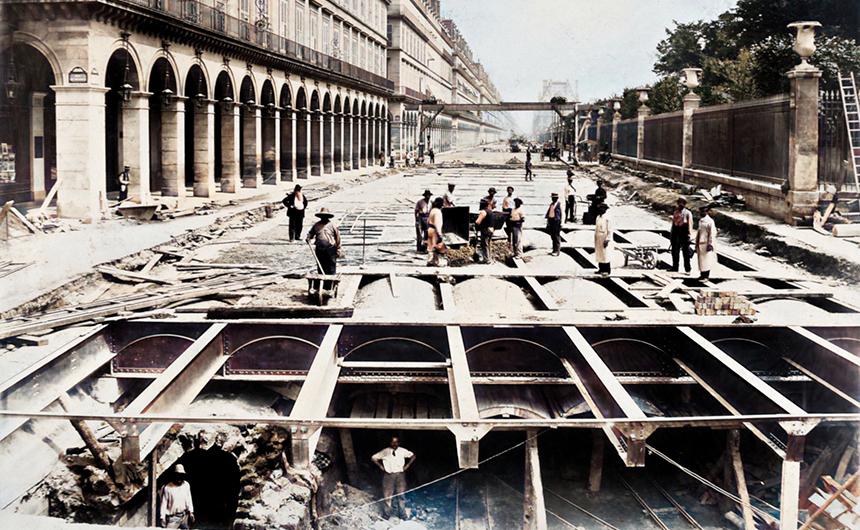
- Cut-and-cover construction: many stations on the early lines were built using this method when there was insufficient clearance between the tracks and street level to construct a vaulted roof. These stations were built in trenches covered with a metal deck. One drawback of this method was that it disrupted traffic at ground level.
- Timber-lined tunnelling method: the most commonly used method, which involved digging underground tunnels supported by timber frames and leading into shafts through which the excavated material was removed.
- Shield tunnelling method: the shield was designed to cut through the ground like a punch, causing minimal disturbance to the surrounding area. This method was favoured for the construction of metro line 1, but was very quickly abandoned as it proved difficult to apply in the varied subsoil found in Paris. The shields moved with great difficulty and caused the ground to shift, with the effects felt on the surface. In total, only 2,540 metres of metro line 1 were constructed using the shield tunnelling method. The running tunnels on the other lines were systematically constructed using the timber-lined tunnelling method.
By 1913, more than 90 km of tunnels and viaducts had been completed and brought into service.
The metro makes its mark on the city’s heritage
Beyond its role in urban mobility, the metro also transformed the city landscape. With his undulating metro entrances and stylised lettering, the architect Hector Guimard infused the network with the Art Nouveau aesthetic. His designs, which have become symbols of the Paris metro, have left a lasting mark on the city’s identity.
1949: RATP is founded
1949 saw the creation of RATP (Régie Autonome des Transports Parisiens), which succeeded the Compagnie du Chemin de fer Métropolitain de Paris (CMP) and the Société des Transports en Commun de la Région Parisienne (STCRP). The company took over a 166.2-km network, comprising 14 lines and serving 270 stations. The network encompassed all public transport in Paris and its suburbs, both underground and above ground.
Travel tickets: goodbye ticket punchers, hello Navigo
For decades, the cardboard ticket, punched by hand by ticket punchers, symbolised access to the metro. With automation and the introduction of the Orange card in 1975, the way people used the system gradually began to change.
Today, the transition to fully digital tickets is gathering pace: since April 2025, more than 140 stations have stopped selling paper tickets. Eventually, all tickets will be available on smartphones or Navigo cards, marking the gradual phasing out of cardboard tickets on the Île-de-France transport network.
125 years old in 2025
To mark the 125th anniversary of the Paris metro, Jean Castex, then Chairman and Chief Executive Officer of RATP, unveiled a commemorative plaque at Porte Maillot station on metro line 1. A nod to history, as this is precisely where the line was inaugurated at 1:00 p.m. on 19 July 1900.
To mark the 125th anniversary of the Paris metro, we’re taking you on a video tour behind the scenes of metro line 1, complete with some interesting anecdotes.
[Anniversaire 🎂] Aujourd’hui, 19 juillet 2025, le métro fête ses 125 ans 🥳
La #ligne1 ouvre en 1900 à l’occasion de l’exposition universelle ! On vous raconte quelques anecdotes 😉👇 #ratp pic.twitter.com/rQm6cT4d0o— Ligne 1 (@Ligne1_RATP) July 19, 2025
Key dates in the history of the metro
- 1852: The year Fulgence Bienvenüe was born; this French engineer studied at the École Polytechnique and the École des Ponts et Chaussées, and drew up the first plans for the metropolitan railway in 1895.
- 4 October 1898: Work began on metro line 1 under an agreement between the City of Paris and the Compagnie du Chemin de Fer Métropolitain de Paris (CMP).
- 19 July 1900: Metro line 1 was opened between Porte Maillot and Porte de Vincennes.
- 10 August 1903: a fire at Couronnes station killed 84 people. To date, this was the worst disaster ever recorded on the Paris metro network.
- 1910: The metro crossed the Seine to link the two sections of metro line 4: Porte de Clignancourt–Châtelet and Porte d’Orléans–Raspail.
- 1934: For the first time, a metro line (metro line 9) extended beyond the city limits of Paris to serve Boulogne-Billancourt.
- 1944: During the Second World War, the Germans shut down metro line 11, with the intention of converting it into an underground arms factory.
- 1948: The law establishing Régie Autonome des Transports Parisiens (RATP) and the Office Régional des Transports Parisiens (ORT) was enacted. RATP was officially established on 1 January 1949.
- 1956: Rubber-tyred trains first came into service on metro line 11, then metro line 1 in 1964, metro line 4 in 1967 and metro line 6 in 1974.
- 1983: The red and green Sprague-Thomson trains, named after their American inventors, were withdrawn from service on 16 April.
- 1991: First-class travel, a Parisian exception, was phased out on the metro. First-class travel on the RER continued until September 1999.
- 1998: Metro line 14, the first in Paris to be fully automated, was opened.
- 2012: The oldest line in Paris (metro line 1) became fully automated.
- 14 December 2020: Metro line 14 opened three new stations to the public: Mairie de Saint-Ouen, Saint-Ouen and Pont-Cardinet. Porte de Clichy station opened in January 2021.
- 2024: With just a few weeks to go before the Paris Olympic Games, metro line 14 was further extended – northwards to Saint-Denis Pleyel and southwards to Aéroport d’Orly. The metro line 11 extension opened on 13 June 2024, linking Mairie des Lilas station to the new terminus at Rosny–Bois-Perrier.